Peace, Land, and Bread!
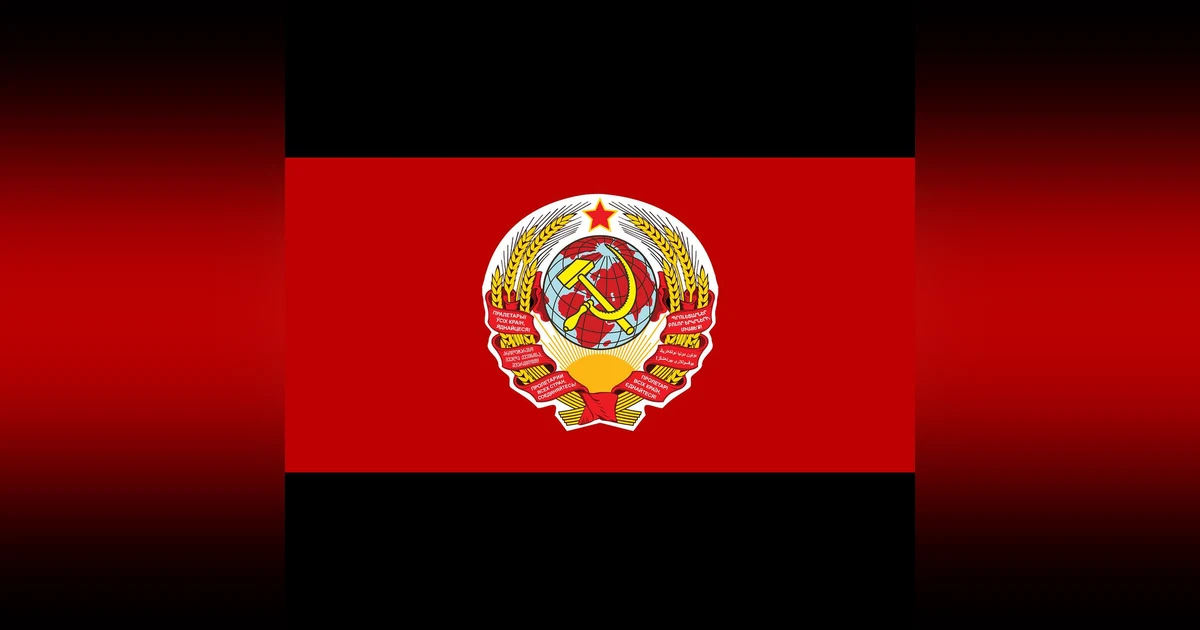


Today we continue our conversation on life during the Russian Revolution and the Bolsheviks' ambitions for the country. Our primary account comes from Elfriede, a young woman living in Odessa, Ukraine when the revolution came. She describes the conflicts between the Reds and Whites, her stint as a typist for the infamous Cheka (secret police), and her eventual escape through Bulgaria.
Bibliography
Elfriede Becker memoirs, Deutsches Tagebucharchiv, DTA 4710-1, translation By Robyn Thompson
Image
Earliest flag of the Soviet Union, 1922-1923
Gütersloh 1975, ISBN 978-3-570-01591-9, Public Domain
In eighteen ninety seven, my dad, who was a notary and traveled as far as Saint Petersburg, hoped the final census taken by Tsar Nicholas II. He came home and said, We cannot stay in Russia. We must return to Germany. Something terrible is coming. During the time she is writing, she lived in Odessa, which would be the present-day Ukraine.
ThadThe last couple of episodes, we talked about the Romanovs, who were the last royal family of Russia. And then the last episode we did, we talked about the story of Anna, who was a girl growing up in Russia when the Bolsheviks came to power after the revolution. And so today we're going to follow the story of Elfrida, who was in Ukraine, which was one of the territories of Tsarist Russia, and her experiences as the Bolsheviks came to power. So recapping a little bit, for 300 years, the Tsars had ruled over Russia. And looking at it from the perspective of a regular Russian person, things had kind of bumped along. The serfs had gotten some freedoms, um, a little bit of industry had started to trickle into Russia, but people still weren't particularly happy with the czars. And when the first world war broke out, life in Russia became significantly harder. So people were even more unhappy about that, which led to a revolution in St. Petersburg in 1917. When the Bolsheviks got word of the fact that revolution was happening without them, they felt rather left out because they had been trying to have revolutions all over the world for literally decades at that point. So Lenin, uh, scared that he was going to miss out on the opportunity of a lifetime, left Switzerland, got on a train, went through Germany, and got himself to Russia as fast as he could so that he could have his Bolshevik revolution. He was joined up there by Leon Trotsky, and together they and a bunch of other people uh overthrew the government that was there at the time. The the one that had rebelled against the Tsar, it lasted for a few months. They got rid of it, and the Bolsheviks came to power. In the first few months, they were trying really hard to consolidate their power.
RobynAnd so they signed the Treaty of Um Prestnikov's. Right. Um, which, well, one of the things they had promised everyone was that they would end the war. And so this was um the treaty was made with Germany. And one of the things that it did um that Anna's family used, and um, as we'll read about Elfreda, um, used was that if you were of German ancestry, you were allowed to go back to Germany. And so that was one of the things that came from the treaty. But it was basically them fulfilling their promise to everyone of we promise we'll end this war that like nobody really wants to be in if you put us in power. And so um Trotsky went and they signed the Treaty of Wrestletowst.
ThadRight.
RobynSo the slogan was peace, land, and bread.
ThadAnd in that order. So the idea being that if the Bolsheviks came to power, they would end Russia's involvement in the war, which, as an aside, was a bit alarming to everyone else because the war was still going on. And if Russia got out of the war, then that entire front of the war would collapse. Germany, they would basically declare peace with Germany and leaving Germany the ability to fight on just one front instead of two. So it was popular with many people that were fighting in Russia, unpopular with many people that were fighting not in Russia. Uh, the next thing that they would bring uh land. So that promise is the promise of equality. The Bolsheviks basically were coming in and saying, look, things have been unequal for a long time. We've had people working the land that you know didn't own it or barely owned it, that have been being exploited by the elite. And we're going to level the playing field. Everybody's gonna get land, we're all gonna work together. So, peace, they're gonna get out of the war. Land, they're gonna share the land. And the reason that this was part of their slogan was that the Bolsheviks were essentially communists, they followed Karl Marx's Communist Manifesto. The idea behind that was that everyone should share everything. The land the rich landowners were gonna be disenfranchised, they weren't gonna get they weren't gonna get land anymore, and everybody would share everything.
RobynAnd they were actually really serious about this. Um, as we'll hear with Alfreda saying, she said, you know, her boss, the guy who was in charge of a whole lot more than her, got paid a thousand ruples, which was the same amount that she was paid. So they weren't kidding about the whole everyone is equal thing. And one of the other things that they did was, you know, if you had, you know, if you'd been a baker or something at the time, then sometimes you would just get reassigned to a different job that they thought was best for you. They were really taking control, trying to make everyone equal, and going from there.
ThadRight. Some might say that this is a a revolutionary idea. And so finally, bread, because everybody was literally hungry at the time. So many uh rations were going towards the war effort that the food shortages were rampant at home, and so people didn't have enough. And so the Bolsheviks came into power, were saying, look, we're gonna have peace, um, everybody's gonna share everything, we're everybody's gonna get paid the same, everybody's gonna have land, we're all gonna work together to build a better society. And oh, by the way, you're also gonna get to eat. Yes. So Russia did have a number of famines, but part of the reasons that they didn't have enough is because they were constantly taking their food and sending it elsewhere. In this case situation, they were sending it to the war effort.
RobynYes.
ThadSo they didn't they didn't have enough food in the cities and in the countryside. Two of the groups that Alfrieda talks about are the whites and the reds. And so having a bit of explanation there. The Bolshevik Revolution, these are the communists. So the communists, they're the Reds. And actually, the the use of the red for their for their symbol for their flags goes back to the Paris Commune from the mid-1800s, which goes back actually it well, it was like 1870, 71. Which goes back to the French Revolution, which goes back to the 1300s. When so the the color red was used to symbolize equality and social progress and the the leveling of the playing field, which is why the communists adopted the red flag, and why, for example, when you see uh communist nations, their flags tend to be very solid red with some other symbology on there. So the USSR, for example, uh took up a red flag with a hammer and sickle. The hammer represented the industrial workers, and the sickle represented the farmers. So it was saying that, hey, we're going to take and we're gonna have everybody equalize, and we're especially going to be looking out for the needs of the workers, the people that are doing the actual work. So the whites are basically everybody else who's against that. So the people on the white side, they come from Tsarist, Russia, and they saw the Reds as they were bad. They the white people saw that this was this was not the right way to go. They were a full coalition of different people. Some of them wanted to see the czar come back to power, some of them were just didn't like the direction that the the Reds were going, they didn't like communism. Some of them were the black hundreds, were ultranationalists under the Tsar.
RobynBut main mainly they were all connected in the fact that they didn't want a revolution. Right. And uh and like Thad was saying, yes, some really wanted Tsar back. Um, another big group were the Mensheviks, that the Bolsheviks, um, yeah, they were the ones that took power from in October 1917. Conservative officers that had been fighting in the war and were still loyal to the Tsar. You know, you have to remember that Russia had been under Tsars uh for 300 years. And the idea of not having that was kind of crazy to them. And people don't deal well with change. And I think I think it's also important to note that Karl Marx, who came up with communism and developed it, um he never saw this working in Russia. So it was, you know, he thought it would happen in England, France, capitalist societies. Right. So this wasn't even like a blueprint that they were taking directly from him.
ThadIt was all and in Lenin and so one of the aspects of the whites that is also interesting is that many of them saw it as a religious crusade. Marx and the communists were explicitly anti-religion. They they felt that religion was something that should be relegated to the past and didn't have a place in a new world that they wanted to build. The whites saw religion as being central to their their society and their government because the kings, the czar and and the other kings of Europe, they saw as being divinely appointed by God.
RobynSo one of the groups that was involved in this conglomeration of people that were basically anything but communism. I mean, they were the whites, but you know, you take like different groups, and I guess it'd be like different interest groups today, um, and put them all together and anything but that. Okay. And so one of the groups that wanted the Tsar back that were early supporters of the Tsar, so since at least the early 1900s, they were basically filling out orders of the Tsar, keeping uh peace. I read in a part of um from someone who was Jewish talking about the pogrims that the Black hundreds were doing after a strike in 1905, but they uh they were strong supporters of the Tsar, and their slogan was Orthodoxy, Autocracy, Nationality. And so these were like religious nationalists. Even today, they still exist today, but they were strong supporters of the autocracy, and that was just one segment of the um whites.
ThadMany of the whites believe that this was a not just a cultural war, but it was a religious war. They believed that it was a fight of good versus evil, um, God versus Satan, and that the war, this Russian revolution, was basically a religious war being fought in Russia, and that that was going to be one of the final battlefields of history was revolutionary Russia. And so they felt that, you know, God was on their side and they needed to uh they needed to fight for their fight for their country.
RobynAnd also at the time, they had help from the Allies, um, who yeah, World War I was still going at the time the Bolsheviks came to power, and the Allies didn't want communism coming out. I think Winston's Churchill said something like, We needed to kill communism in the cradle.
ThadRight. So the thing is is that communism had been a political movement that had spread its seeds a little bit all over the world. And so there is there was already a resistance to that ideology worldwide. So when it took root in Russia and started growing, many of the other political people in the world took issue with it. Like it was a problem. And they and they felt like they wanted to go ahead and weed it out before it grew.
RobynAnd this was like even a problem in America. Um, because you don't think about communism being everywhere in the world at that time. We talk about the red scare happening, you know, later in history, like more recently in history with McCarthy. But the first Red Scare was really in the early 1900s against anarchists, people like Emma Goldman, who Herbert Hoover called the most dangerous woman in America. And they were, they were literally deporting these people that were U.S. citizens, deporting them to Russia uh because of their beliefs that were too communist, um, too anarchist, too against the, you know, well, for the United States, the U.S. government.
ThadRight. So they yeah, they so this was uh this was a thing that people were worried about even before the Russian Revolution. And so when they did get to the Russian Revolution and and had the Bolsheviks come to power and communists come to power, the the West was kind of worried about it. So that's the the scene that you get when we come to the point in Elfrida's story where you see the the Reds versus the whites. It is the Civil War, and it is the Reds, the communists, fighting for survival. When they first came to power, the the Reds, the communists, the Bolsheviks, they all wanted there to be peace and harmony. For example, they wanted to abolish capital punishment. That's it, they didn't want to have the death sentence anymore, because that's something that the czar had used, and that seemed unjust and it wasn't right, and they you know they wanted to handle things peacefully. However, that lasted for about three months. Um, once they realized that the people that were coming against them were playing for keeps. The whites, uh, in trying to gain back control, uh, instituted a policy of trying to subvert them in many different ways, including assassinating the leaders themselves. And so at the same time that all of this was happening, the Reds responded by fighting against them with an equal level of brutality. So they would round people up, they would kill them. Uh, Elfrida mentions night rides. When they were trying to purify their ranks or purify the countryside of the influence of the whites who they called saboteurs and wreckers, they would use the secret police, the the Cheka, is uh is an organization they created to root out people that were not sufficiently loyal to the Bolshevik cause. They weren't real communists. And so they would take these people in the middle of the night and interrogate them. And sometimes, you know, that interrogation would end with them, you know, going to the gulag somewhere, and sometimes that interrogation would end with them never coming home again. That was not uncomfortable.
RobynBeing executed.
ThadThey would be executed, right? And so, you know, they felt the the Reds felt that, well, this was only fair because they were under significant attack from internal and external forces. They were infiltrated, they had people that were that were trying to work against them at many different levels, and so they felt that they were justified in using significant violence in order to oppose that.
RobynAs we'll see, there were um there were uprisings in the countryside of people, like farmers and small villages and people supporting the whites that would rise up against the Reds. Oftentimes uh everyone involved getting executed or sent away to, as Sad said, Northern Russia. But also one of the ways that the uh Reds, it was also called the Red Revolution. And one of the ways that they were able to get people to fight on their side was that in June of 1918, so about eight months or so after the initial revolution, uh, there was a mandatory conscription of peasants from Trotsky because they wanted a larger army to fight everyone else. And if people were like, Yeah, we don't we want to do that piece out on that man, then they shoot them or take hostages, or they would join the army, but then they wouldn't have the conviction to want to fight. And so it wasn't like they were able to get more people who had the spirit and the love of a revolution, but they were able to have a bigger army mainly by intimidating them to be in the army.
ThadRight. So it turns out that the the peace part of peace land and bread only lasted for about six months until it turns out nope, actually we do need you to fight. It's just not going to be against the Germans, it's gonna be against everyone else who's coming to stop us.
RobynAnd on that note, the bread part, um, as we'll uh hear Elfrieda say, you know, but well, basically all they had to eat was uh cornbread for a while, and they were given barley that had used to be being eaten by the horses. So you could say that they also had bread.
ThadAnd it's in this realm that we enter into Elfreda's account.
RobynQuote The streets often had battles, shootings, and no sense of who was in charge. There was nothing to eat and almost no water. Changes were common between the warren factions of the Reds and the Whites. One year I noted the change of government, thirteen changes between white and red. At night, we slept on the floor, directly under the windows, so that the shattering glass whizzed over us. In the mornings, when it got light, we tried to figure out from the window whether the city was in the white or red hands, and could tell from the ties that the soldiers had tied, white or red, on their bayonets. Only in this way could combatants see who was friend or a foe, because the troops on both sides were dressed in remnants of uniforms of the same kind. Choosing a career or pursuing further studies for me was out of the question, and we wanted to leave. The food situation was becoming increasingly difficult. For a while, all we had was cornbread. Previously, barley was only for the horses. German farmers were almost exclusively wheat growers, and when the barley ran out, we ate cornbread. But that soon ran out too. The city of Odessa got its water from the Dienster River, but the water shortage became increasingly noticeable. At first, water was available for a few hours each day. Later, if you were lucky, you could buy a liter of water on the street. The filth and neglect in the city grew increasingly worse. Everyone and everything was infested with lice. Epidemics broke out, typhus above all, also cholera. People spoke of the plague. Many died of general weakness. My brother worked in Alt Fordenthal for a German farmer in July and of August 1918. In the Odessa region, the German farmers decided to come to the aid of the White Army and risk an uprising against the Reds because they did not want to participate in the Red Revolution. That summer, a battle took place in the field of the colony near Odessa. Within a few days, the German farmers were completely wiped out. Executions and looting followed, and later, lifelong exiles to the unconquerable forest in the far north of Russia. Eventually, this led to the dissolution of German colonies. My brother, who was 18 years old, fought in that battle. He was hit by a Bolshevik bullet and was said to have died instantly. My mother and I always knew that the human body is sacred. How sacred? We had not experienced in its full depth. We wanted to find my brother's body, to find him at any cost. Even though everyone said, it's impossible in this heat. Days have passed. My mother and I searched for him on the battlefield for days. We were barefoot in the scorching steppe dust with our sandals slung over our arms, a deathly silence all around. No people, no livestock. The fields had not been harvested because of the war-related unrest that summer, and the dead men lay in in the field. We felt no hunger, but we suffered greatly from thirst. The scene was the same on the step. Dead. Not a person, not a single animal, not even a bark of a dog. Once we went through a German settlement and decided to knock on the door. We sat down. After a while, the housekeeper came out and asked what we needed. My mother asked for drinking water and told her that we'd been traveling for days looking for my dead brother. The housekeeper went back into the house and locked the door firmly behind her. Then a priest appeared on the steps and listened to us. He told the housekeeper to fetch the women some milk from the cellar, and then he left. The woman brought us a small jug of cool milk, set it down, and then disappeared again. We have never forgotten this refreshment. My mother and I went to Fortenthal for a while. The schools were closed, there were no classes. At the parents' request, I gathered a few children around me and taught them. In return, I received bread and sometimes milk. However, this only lasted a while, and I had to look for work, and only service to the state was considered work. I was offered a position as a typist at a branch office of the military court in Freudenthal. The first job of my life was at a court martial. My superior was a nobleman who made no secret of his conservative views. He had helped me get the position, probably to ensure I received the 1,000 ruples weekly salary. Weekly salaries were the norm back then. He himself, as head of the station, also received only 1,000 ruples a week. Everyone the same. He advised me bridge this time by learning to type perfectly here. Acquire perfection in a field. And that will give you a lifeline. The relative security did not last long. My superior, my next superior, was very different. He came from the Baltic region and seemed relatively young. He had lost his memory after being buried alive in the war and was therefore completely unable to work. He sat opposite me at the desk, didn't say a word, and heard nothing of what was going on around him. The secretary presented him with documents, he signed them in his beautiful handwriting, which suggested a high education, and sat there again, completely silent and apathetic. I knew that night drives took place, but where and why remained unknown to me. Only gradually did it dawn on me that I was not meant to know some of what happens at court martials. I was never present during an interrogation. Once there was an execution. I had to travel alone with the Baltic man across the Russian steppe in the dark of night, even though it remained a mystery to me what I was needed for and what was happening. My situation had become untenable and I had to consider a change of occupation. My mother went to the city and asked a professor of music we knew to help me get admitted to piano class at the music academy. He was from Vienna and had lived in Odessa for a long time. Shortly after my mom talked to him, I became a student. Now all that remained was to get myself out of the court martial work. I explained my situation. It was autumn, the winter semester was beginning, and I had to return to the city. Well, if you go into the city to study, that's important. Then we'll release you. But it wasn't enough to have a student ID. I also needed a work permit, and those were only issued to those who worked for the government. So after arriving in the city, I immediately went to the general registry to register. However, I still had to take a typing test at the employment exchange, and I couldn't type at the time. Nevertheless, I wasn't afraid of the test. There was no typewriter in our office, nothing at all. No pencil, no sheet of paper, no files, nothing. So primitive, that's how difficult the construction of the new Russian Socialist Empire began. From nothing arose the much desired culture and conquest of the whole world. At the employment exchange, a young girl tested me on typing in Russian. She couldn't speak German. I searched for the letters on the Russian typewriter, but I couldn't find them. The test lasted a few minutes. Then the young girl said, I assume you can write German better, so I'm just going to issue you a certificate. Passed. Shortly after, my new employer, who was called Sieber, appeared. Sieber was merely the name that was used to refer to Germans in general at the time. The entrance to our office building was guarded, especially when there was one of the numerous events after work that were called meetings. Speeches were given, slogans were issued, the Marseille was sung, in Russian, political indoctrination, but at the lowest level. It was nonsense what they offered. The speakers knew nothing. They were completely uneducated. No one could be seen as being of the intelligentsia who had first welcomed the revolution. The intelligentsia were persecuted and exterminated because they could not be trusted. The office building had a basement. In the basement were the torture chambers of the prisoners. That's where they were killed. It was a horrifying feeling for me to stand above these chambers. In the harbor, a ship named Almus was clearly visible, on which there was a Cheka execution site. People were mutilated there, killed, tied with a stone around their necks, and thrown into the sea. After a change of government, divers were commissioned to search the seabed at this spot in the harbor. They were met with a gruesome sight. The dead moved with their feet upwards and times with the waves, like a forest of trees. Meanwhile, my fate took its course. I was now at the general central office of the German section of the Cheka. My superior was called Gebhard. He was the highest ranking official there. My task was to type up the handwritten appeals and calls to action from him. But no one cared how long this work took me. Obviously, Gebhard couldn't judge it because he didn't understand any of it. It was clear that he had only a basic elementary education. It's surprising because I thought that elementary schools in Germany were a higher standard. Gebhard was German, a baker by trade, before the Bolsheviks came to power. We wanted to leave and both tried clandestine and legal routes to get out. To this end, I went to various offices. For example, the German consulate, which existed in 1920 and 21. The consul, however, as I later found out, had a fellow citizen and they would never have lifted a finger to help my mother and I. I spoke to people at Russian offices. They were even less interested in preventing me from leaving the country or escaping. The German and Austrian Cheka didn't want to let me go. They desperately needed me, since I knew the country and the language better than they did. I didn't realize how important I had become to these men. One day, a man I didn't know at all appeared at the police station, broad shouldered, tall, strong, heavily armed, a Czech, without a doubt. The man was extremely friendly and began a conversation with me that deeply frightened me. He had been transferred to Moscow. Moscow was designated as the center of the future world. He told me that the Russians wanted to take me with them to Moscow, and I could serve as a translator, as well as a typist, but Sieber didn't want me to leave. They argued about me. I was so disheartened, so pale, so thin, so frightened, I was not even a party member. But none of that bothered them. One of the next days, Sieber came to me and said, So and so, I don't remember his name, wants to take you to Moscow. Since I was prepared for what was coming, I answered with I don't want to go to Moscow. I'd rather stay with you. I informed my mother every day about everything that was happening to me. She was horrified at the thought of me being ordered to Moscow and kept saying we have to leave. Illegal immigration or escape was particularly difficult and dangerous for us under these circumstances. In her worry, my mom came up with the idea of a sham marriage for me with a German medical student whose brother was studying law at the University of Tubigan. But the success of this ruse was quite doubtful, as it was too well known and frequently used. Moreover, force prevailed over justice here as well. The fact that the two scoundrels disagreed on who would get this valuable worker, me, who spoke both German and Russian fluently and was also familiar with local conditions, delayed my forced assignment. The arguments, which took time, left us in limbo, and the time left in limbo was my salvation. True wisdom always considered the unseen, it is said. With us, wisdom had no room. We were shaken by fear, both very weak, and had nothing to eat. The city was without water, the filth was indescribable, everything was teeming with lice. There was also typhus, cholera, and talk of the plague. Then Sieber informed me that I was dismissed. Inflation had progressed so far that the state could no longer pay salaries. When I told my mother this, her first thought was I'm going away. But I was so ill I could no longer get up. It was typhus. My mother was desperate. Tell me, where should I bury you? I told her that I wanted to be buried in Freudenthal, using my brother's grave. Of course his grave had not but yet been used. I remember I wasn't preoccupied with the thought of an afterlife, but rather tormented by the question, where will my body be laid to rest? And will the funeral be sacred? A massive wave of death had begun, even in the country. In the city there were so many dead that relatives and neighbors could no longer bury the bodies themselves. The city administration took rigorous measures, horse drawn carts drove slowly through the streets, a handbell rang, and every house was required to drag out its dead into the street beforehand, where two men, equipped with large pitchforks, threw them onto the trucks. The dead sometimes lay in front of the house a little longer, which led to grotesque scenes. To dispose of the dead body, the caretaker waited for darkness and then dragged the corpse to the neighboring house. There, the responsible caretakers peered behind the gate and dragged the body back. Thus carts traveled through the city streets to the cemeteries far outside the city and through the dead into the mountain high piles of corpses, stacked there, and they were all stark naked. Grave robbers took every scrap of clothing, such was the shortage of textiles. The corpses were teeming with lice. Young soldiers had to dig the graves because they were the only ones strong enough. In doing so, they themselves became covered in lice, and most of the time there was no saving them. Several German students had heard about our dire situation and were looking for a doctor for me. Doctors had become scarce. They were the first to die. When they found the doctor to help me, he asked, Is it a woman or a man? If it's a woman, I won't come. One can assume she won't die. Women have healthier hearts. But then the unexpected happened. Relatives in the USA had been given the opportunity to send food parcels through a relief organization. We received sugar, flour, cocoa, some tinned milk, and other things. I remember my mother feeding me sugar by the spoonful to give me strength. There was no way to cook. We'd been trying for some time to secretly meet up with a few people for an escape attempt. It wasn't the first attempt. In the end there were four of us women, an elderly deaconess whose mother house was in the border province of Bessarabia and who was also born there, a young student who was returning to her parents, and my mother and I, who were also born there. There is an inter international law according to which a person has the right to their homeland to where they were born. We were counting on that. We thought if we crossed the Russian border we would be safe. As soon as I could stand and walk again, we looked for an opportunity to get closer to the border. The border was the Deanster River. First we had to get out of the city. We found a man who had come to the city from the countryside with a horse drawn cart. He said that we would need to pay him, but of course we agreed. We rode in the cart to the border to be inconspicuous. After that we got off and walked alongside. The man looked trustworthy, but we remained careful to conceal our intentions. He wasn't Russian, but he spoke Russian, and so we were able to converse with him. Our destination was the Kutchigun Valley, named after the river in the steppe. German colonists had settled there, and I can name the three settlements Selt, Candle, and Baden. I cannot say how far it was from Odessa there, although it was impossible to reach in a single day. In the evening we arrived at a farmstead that had been deserted for a long time, unlocked, completely empty, but clean. The four of us women lay down on the bare floor of the house. On our walk from Odessa to the valley, we frequently encountered soldiers, indistinguishable from the reds, all dressed in tattered remnants of their uniforms. Once I had a brief conversation with a young soldier. He struck me with his great, almost perfect beauty, further emphasized by purity. A saint? In this area? On this road? He spoke with the best Russian imaginable. I took him for an educated Russian. He smiled. I'm not Russian, I'm Burat. He had come from the internationally populated city, Tartars, Jews, Asians, including some from Central Asia, and many Germans. The demographics at my school were similar to his, but I had never met of Europe before. The young man was European educated with the best upbringing. He was tactful and very curious about us. Where were we from? Where were we going to? That was only natural, given the proximity of the border. Saints and cr saints and criminals close to one another. This still exists in Russia today. Back to our hike in the valley. We asked our guide Dimitri about his family and other circumstances and learned that he was married and has his own house and farm in a Moldovian village that bordered directly across the river. At this point the Deanster had islands, and on these islands were the gardens of these border residents. These were now considered no man's land and could not be entered. We asked Dimitri if we could visit one. At some point he dropped the mask and told us that he understood German. He'd been a prisoner of war in Germany for a considerable time. He'd done well there, he had three German brides. How convenient for us, these pleasant memories of Germany. He said that he'd seen through our intention from the beginning. Would he help us? Yes. In the Seltz colony, the deaconess had a close compatriot from Bessarabia who had promised to help us, but first a boy from Seltz led us to Dimitri's house. His wife had already been told we were coming. We walked around the village as if by chance to get close to the riverbank and scout it out. In the evening, several men came to Dmitri's house and had a lively conversation in Moldovian, which we didn't understand. We had to trust them. We stayed there for a few more days. Dimitri's wife spoke Russian and she invited us to lunch. There was a usual Ukrainian and Russian food, cabbage soup, borscht. It was a real treat for us starving city dwellers. At lunchtime, she untied her apron, spread it out in the yard, and placed the cooking pot of soup on it. We all squatted down around us, and each of us was given a wooden spoon, and we enjoyed the meal. Then Dimitri told us that he had discussed our request with the men that evening, and they agreed to take us to the border. The cost was a very high sum, but it would be worth it. The whole village knew of our presence, and we weren't betrayed. They didn't let anyone know about us. We walked back to Selts in the heat and dust. There we packed up our small bundles, some provisions, and our papers. We arrived at Dimitri's place in the evening, after dark, and were then led onward. It was pitch black night, the air completely still. This was intentional and had been planned. In that region, mosquitoes are a terrible plague. They were most bloodthirsty on still nights. We were led into a poor farmhouse, and there our money was handed over. Now that they had the money, they could have said we don't know you, but they told us to wait. I prayed, as I had throughout the entire escape. When will I be allowed to say, like Martin Luther, I made it through. At some time we were called out and given whispered instructions on how we should behave. We crept forward, the men following at a distance. From time to time they gave signals lie down. Then they gave whistling signals, and the same whistle was returned. Get up, keep going. The deaconess was hard of hearing and very agitated. Like many hard of hearing people, she spoke loudly and asked, What did he say? An nudge in the side always brought her to her senses. Every whistle could have meant here they are, take them away. Finally, we reached the bank where a water craft stood. It was a box and a farmer's wagon which had been tarred to make it impervious to water. The box had to cross the river, which is narrow at one point, four times that we had to pass across because it could not carry all of us. No more than two people could go at a time. When my mother had been taken across and I was still standing on that bank, it would have meant separation for life. When all four of us were over the river, we climbed up the thicket and went inland, constantly worried about encountering the border guards. The area was completely overgrown, no path, no footbridge, sometimes only traces of formerly cultivated orchard could be seen. The mosquitoes raged terribly, their buzzing filled the air. In their greed they penetrated our nostrils and earlobes. We had cloths tied tightly around our heads. They penetrated and pierced our scalps. I suffered the most. My mother took pity on me and said, Scratch yourself, poor child, perhaps it will bring you some relief. So we walked aimlessly, only striving to get away from the bank. When morning came we saw a path with horse manure lying on it. How immense our joy was, we had left no man's land behind us. It was already light when we arrived in a Bulgarian village. I remember that cattle were driven to the pasture and farmers were standing by their gates. They, because they lived on the border, they immediately understood that we were immigrants, and a wave of sympathy washed over them. The local population got supplies together and gave us fruit, milk, bread, cheese, butter, and bacon.


