Preserving the Past
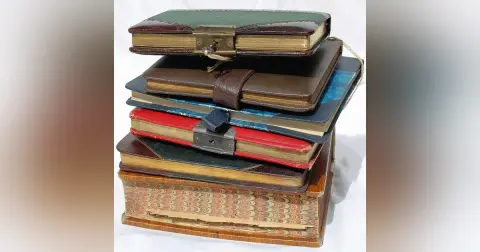


What's the difference between a diary and a memoir? In this episode, we take advantage of an opportunity to interview Christiane Weinzierl from the German Diary Archive in Emmendingen, Germany about diaries, memoirs, and the art and task of preserving the past.
You can find out more about the archive at their website: https://tagebucharchiv.de
0:00 Look, voted this part out. Krista. Does the giggling belong? No, absolutely it does. Maybe so. It's a popcorn. Because at the end of the day, we're here to tell people stories. And our story is people that can't pronounce words. Last year, while we were doing research, we found ourselves in the German Diary Archive in Amendingen, Germany. Last month, when we returned, we were able to sit down with Krista, who volunteers there, who gave us some background on the work they do.
0:42 So will you tell us about yourself and the archive? Yes. Why have I got involved helping in the archive? I've been a diary writer myself from the age of uh 14 on. I got a gift, a diary for my confirmation when I was 14. And so I decided to write diary, but only travel journal. And I'm still doing this. Have been doing diaries from all my travels since I was 14. So I know about diary writing and what a writer thinks. And I know, uh tell about you about this later on a bit, maybe, um, what the difference is writing a diary just for yourself, or writing a diary of which you know that other people are going to read it.
1:32 Originally, my travel journals were only for myself, and then when I first met my husband, from that moment on, I was 20 then, he said, I want to read it. And my style, my writing style, started to be different, totally different. It's because I knew he would read it, my son, my daughter-in-law, my mother-in-law, they all want to read it. So things are still true in the diary, but they are told differently from my original diaries that were only for myself and never meant for any other eye or ear. And so it was clear to me when the archive opened here, and I was still working, uh, that after retirement I'd become a volunteer here and do something useful in retirement.
2:21 Meanwhile, I retired in uh 2019, and um, meanwhile, I'm a member of the managing committee, and I'm the one responsible for anything and everything that's English and French, uh, such as our translated Instagram texts, such as uh contacts to the other European archives, or and then I do guided tours in English, German, French, presentations of the museum here, and away presentations as well. Next week I'm having one in France over in ASUS, and uh I'm responsible for the uh yearly public readings, the big public reading that we do.
3:05 That's my job here. That's very cool. So, how long has the diary archive been here? How long has it existed? Uh it has existed since it was uh founded in uh 1998. So we had our 25-year big celebrations uh three years ago. It was in January uh 1998. It was founded by a lady from Emmendingen who she's still alive, she's still there, um, very, very uh much committed to the well-being of her local town here. And so she got the idea actually from the Italian archive that had opened in 1984 already.
3:53 The first of all the European uh diary archives to open was the Italian one. Her sister worked there as a volunteer. And when she went to visit her, she said, Wow, we need this in Mendingen as well. And that's why most of these diary archives that have all been founded by a private person, they are situated in towns that nobody knows, absolutely unimportant, uninteresting towns in Germany, in Italy. Nobody knows about the do you know Italy? Ever been there? No, not yet. Uh okay, in Tuscany, in eastern Tuscany, there's nothing there.
4:36 Woods and wolves and nothing but the Italian diary archive, because the founder lived there. So that's why it's placed in Emilina. She started with a few lady friends collecting diaries in her living room until her husband said, Well, what are all these books doing in their room? Can't you find a better uh place for them? And since then, the city council, the mayor, it's only our second mayor since then. Both have been very, very positively thinking about our archive and have always helped. Um we got the this location here, this wonderful location, and uh we don't pay rent for it.
5:23 That's uh what the uh town of Emmendingen, the city of Emmendingen does for us. Wow. From the beginning, this lady, Mrs. von Troschke, from the nobility, uh a noble title she's got. Uh the purpose of the Diary Archive has always been collecting and storing autobiographical documents for safeguarding them for the future and for historical research. Very, very important. I mean, you are researchers. Uh we receive about 200 research demands per year that we've got to uh satisfy.
6:03 Um the documents we collect have to be unpublished ones. We don't collect published things, and they have to be from ordinary people. The man in the street, so to speak, woman in the street. Famous people go to other archives. There are special archives for the military, for writers, for musicians, whatever. So we are for just ordinary people uh that write ordinary diaries that would get lost if there wasn't a place uh to store those diaries. So you specialize in just the the men on the street? Yes, exactly.
6:43 And women. But we have uh slightly more diaries from men, actually. It's 57% male authors. You always think diary writing that's something for women. It doesn't seem to be. Um it's for uh men as well. In war times, men wrote diaries, and now um in the last, let's say, five, six, seven years, um, memoirs. It's autobiographical memoirs that men write. Women don't. Men think, oh, my so important life mustn't get lost.
7:23 I must write it down. So we are um kind of uh flooded with memoirs. We don't take them all any longer because there are they are too many. Really? Storage is costly. Yeah. Yeah. Yeah. Makes sense. So you focus mostly on just diaries but not memoirs. Um diaries and memoirs, what we don't take any longer, only exceptionally is correspondences. So a a question. And this this ties into the the memoirs versus diaries. You you said earlier that when you started your diary, you were writing for just yourself, and then your writing changed when you realized that other people were gonna be reading that. How did that change for you?
8:05 And when you're looking at other people's diaries or memoirs, how can you see that they write differently? Or or do you notice that they write differently? You you you see it. You see it. When we do our public readings, we absolutely prefer diaries to memoirs. They are much more lively, much more spontaneous. They go a lot deeper in emotions, in personal thinking. When you see it all from a distance, and the longer the distance is, the more distanced uh you yourself become from the events that you're telling about. Um, we usually say uh they are gilded memories that are written down.
8:52 And um in a way, my travel journals are kind of gilded as well, because I know my mother-in-law is going to read them. She doesn't want to read anything negative about her son. Uh when we had a row about uh whether to have a uh day just by the hotel pool or go visiting another site. I'm always the one for the site, and he's the one for relaxing, and we have a row. I just write down um we had to come to an agreement about how to spend the day. I won't write down we had a vicious row, but uh I used to write such things down in my original diaries.
9:38 And you know, uh during uh COVID, during the lockdown, I digitized all my handwritten diaries, the photos and all, because I have those books, I have them done, my diaries together with the photos and scanned ticket entry tickets and all that. Um so I did that, and I was so ashamed of some of the things I wrote down in my early diaries uh that I started thinking about leaving things out. And then our president said, don't do it. Either you write it all down or you quit the whole thing. Uh you must remain true to yourself.
10:20 And actually, some of my old diaries haven't gone to either my husband or my other family. Because you keep themselves, you keep the child. Yeah. I I just don't want them to read this. How I thought, how I behaved. Um, for example, when I was 19, I have relatives, I have family in Brazil. So at the age of 19, I went to visit them for some weeks. And what did I do? I mean, they belong to the upper class of Bahia, the town. Um, what did I do? The 19-year-old leaving Europe for the first time in my life, lecturing them on how can you see all those miserable people in the street?
11:06 Why don't you do anything about the slums? When we had huge invitations and dinner parties, I said, Do you enjoy your food? Are you enjoying what you are eating? Don't you think of the slums? People outside. And what must they have thought of me, the family, the girl, the stupid girl from Germany, telling them how to deal with their poverty. It wasn't my place, but I didn't realize that, like realize that now, but I didn't then. So I wrote it all down in my diary. Yeah. But I don't want other people to read how uh silly I was and thought at the age of 90.
11:48 So let me ask a question. As a diary archivist, you read lots of people's diaries. Do you find it more educational or more beneficial to read people's raw emotional diaries or their more gilded thoughts? The raw emotional ones. Yes. Yes. They are sometimes difficult to read because um you know what happens when uh a document is uh submitted to us, uh, it goes to a reading group. So every and each document is being read, and the reader filled by reading groups, uh, they fill out a spreadsheet according to guidelines. You can't just write anything into the spreadsheet, but uh strict guidelines, and then the spreadsheets go to another group that puts in the catchwords that you noted down uh into the database so that you can find it.
12:42 Oh, the super useful. You've never, once it's stored away, you'd never be able to find it. And when researchers come like you and say we are doing research on this and that topic, we need something, um, then uh we've got to be able to find them and give them the food they are asking for. So you need to remain objective, distanced, cool. But it's sometimes very, very difficult with those persons. It's never difficult with the gilded ones, with the memoirs. You just read them through and fill out your spreadsheet. But the other ones are sometimes hard to digest.
13:22 And it's hard to keep your distance. You get angry with it, mad at the person writing, why don't you pull yourself together, behave yourself, or uh, oh dear, you poor thing. And that might influence the kind of notes you take down. But the researcher, you are not interested in my feelings when I read the uh diary and filled out the spreadsheet. You want to have an objective overview of what am I to expect from the diary. So you often put it away, do something else, and pick it up again. Um, but uh they are a lot more authentic, spontaneous, immediate, raw.
14:08 Yeah. It gives you insight into the person, into the time, the places they were. Exactly. The person, the time, um, the how they experience it. You find a lot of things, very, very personal things, that you don't find in any history book. And if such a private person didn't write them down, you'd never know about it. That gentleman over there, who's my favorite, Emil Robert Schneider, living in the 19th century, a burger, a Berlin burger bourgeois family. Would you know? Where would you look for knowing how did such a young man propose to a woman he wanted to marry?
14:50 How did he go about it? Would you know? No. No. You you don't find it in any history book, but he writes it down in his diary. Do you want to know? Sure, yes. Yes. Um, he his first wife, we don't know how he uh wooed his first wife, but she died uh very young um from a little infection on her lip. It went into her blood and blood poison. Yeah, yeah. Um well, um, it got infected. The doctor cut it open, that was the wrong thing to do, and uh within a week she was dead, leaving three little children. He needed a second wife to look after the children, uh, which bore him in who bore him another 11 children, actually.
15:35 Almost nine of who uh survived him, by the way, but only one, one of the children, one son, um made it through to this generation. When we read him one and a half years ago in our public reading, this family, all the cousins, etc., they came and listened uh to the public reading, and they were all from one son, the other eight withered away, and nothing came of them. Um back to how he proposed to the second. He went to the he still had this same uh GP, his doctor, that was responsible for the death of his first wife.
16:19 He writes down in his diary, I asked Dr. Carter if he had any objections concerning the uh health of Miss Julie. Julia was her name. And he said he didn't. She was in perfect health. Then he goes for a walk with Julie and writes it's all in the diary. And then during this walk he says to her, Julie, uh Miss Julie, I asked Dr. Carter about your her health, and he says he doesn't have any objections. So that's why I want to ask you if you want to marry me. And she says yes.
17:01 There we go. Yeah, I mean it's out. Exactly. The doctor says it's okay, so you know. And it was okay. She died of a liver disease, but um only after she'd given him eleven more children. Yeah, so she was okay for a long time. She was okay for a long while, actually. Yes. Wow. Yeah. So you find such things only in the diary. And I don't think if he had ever written a memoir, he wouldn't have gone into this detail. He would have told about the first wife, about the second wife, but not such detail. So it's the the details in the diaries that give us the texture of what people's lives are like back here. Yes, absolutely. Very cool.
17:41 Yeah. And maybe I can already tell you why that one's my favorite. Why is it your favorite? Uh he has written, as you see, 19th century, and as you see, over a span of 50 years, every day. It's all in that showcase there, his diaries, uh, from when he was 17 until the day he died. Or most the day he died. You get to grow up with him and see him evolve throughout. And I've read them all, 43 volumes. I've read them all, and so I know everything about this life, and it was a fascinating life. You live, you feel, you suffer with this person.
18:24 You are happy with this person. Uh the 19th century, of course, is a very interesting era in Europe. Um, he witnessed all this technological, technical progress, all the inventions, the industrial revolution, gives his comment, electric light, distasteful. He writes down in his, yeah, in his diary, that was the first reaction to electric light. Um then he witnessed several epidemics, like cholera. How did the authorities in Berlin, where he lived, which was the hub of Germany, the hub of Europe was Berlin in those days.
19:07 Another hub was London, the two hubs that were intermarried, uh, the King of Prussia and the Queen of uh Queen Victoria. She married uh most of her daughters off to Germany. So the two hubs. How did authorities deal with cholera, with a cholera epidemic? He witnessed them. The the prisoners had to carry the corpses in uh wooden crates uh along the streets, uh, yeah, past his house, past his home. Um he witnessed the revolution, the German revolution of 1948. It started in Berlin. The very outbreak was in Berlin.
19:49 He witnessed it, he writes about it. How did the king react to the first outbreak? He stepped onto the balcony of his palace, he lifted his hat, waved it to the public, the public cheered to him, and everybody went home and said, and the king too went inside, and everybody thought that was it with the revolution. But no, that wasn't it. He writes about a lot about the Prussian king whom you witnessed, so he could go to the palace and look at him every day he wanted, and he later became emperor, so uh very important person. So you really get into the everyday life of a Berlin Burger's family.
20:31 Very cool. So so you've got him as an example. Are you still taking diaries from people to that are writing today? Yes. Yes, yes, so you for diaries from ordinary people from any point in time. Yes, exactly. We've got those um permanent donors, uh donors, so to speak. They write, and once a year they hand in. So, of course, that means while writing, they know they are going to hand in. They think maybe they are going to use it for a public reading, for research, etc. Of course, they write differently from him. Right. Does anyone hand you diaries?
21:13 Do you have a just a program that um there's uh an embargo or holds the diaries private until those people have passed away? We don't do this. When uh the um the donor that wants to submit, it can be the person himself, it can also be the descendants. Most of the time it's descendants of the author, um, have to sign a contract, and with a contract, they hand over all the rights into the diary to us. We can do kind of whatever we like, not quite kind of whatever we like. But if they say we want you to store it, but for the next thirty years you are not allowed to use it for research, we say, No, thank you.
21:56 Uh take it back home. Keep it you keep it good. Exactly. We won't store it for you. Right. Then we take only the diary. Some people come with volumes of they have kept every single contract they've done with a repair, renovation of their house, whatever, and they want to hand it over all that whole the whole of their life. And we say, no, no, no, just the diary, uh, take back anything. Because storage really is risky. We don't store in here. We've rented three huge rooms in an old, in an ancient factory, but it's not a factory any longer.
22:40 Uh, and we've got to pay rent for the for the rooms, which is really costly. Right. So it's a cost, but you also have to maintain uh environmental conditions, right? Yes, and they are perfect in that factory, right? No daylight, always the same. It's like subterranean, uh like a cave. Uh it's always cold in there, but a dry cold. Right. Never damp, dry cold, no direct light. Um so uh that's uh no dust. Yeah, no dust, yep. That's perfect there. So you've just out of curiosity, you've told how many how many diaries would you say that you have? We have about 29,000 documents by now.
23:23 A correspondence is one document, not the single letter in it, but the whole of the correspondence. 29,000 documents, three and four are in fact diaries. Uh we've got about uh 5,900 authors for these 29,000 uh documents. So as you see, uh as you're going forward, you talked about how you had digitized your diaries. How many of those are digitized or you have pictures of? About 30 percent. About 30%. One in three. One in three. And we digitize what we digitize first of all, have to digitize, is those that are written in the old German script.
24:06 Oh, yes. Uh they've got to be digitized first because they go to people that can read them and will transcribe them into Latin letters, Latin, Latin uh handwriting. Yeah. Yeah. The old script. Uh I was looking at one yesterday. Yeah, it is the the note on it from the reading set. Yeah. This hasn't been translated yet. It's it's sure to be a an R hidden gym. Yes, and I opened it up and it was just I it couldn't make out anything. It was just like scribbles. We don't know about the hidden gems in there, uh, because nobody can read them. So we've got those uh people that uh around 20 nationwide.
24:49 They don't all sit in the region here, but nationwide. And of course, uh the documents got to be digitized before we send it off to them. And luckily, we have got uh the help of an AI that does it fairly quickly, really quickly and reliably. It costs, but uh our treasurer says, yes, I'm willing to spend a lot of money on this AI because it really, really speeds up the translation or transcription. We we rather call it transcription because it's all German. It's not a translation.
25:30 Right, right, right. Um it really, really speeds it up. And I think at least a third of those people dealing with transcription, they have warm getting gotten warm with the AI. They are all elderly people. We are all volunteers, all in retirement. And some say, no, no, no, AI, that's not for me. But the others that do, they demand food, food, food. So we really uh the documents have got to be scanned and then digitized. We've got three very uh expensive, very good scanners. Upstairs, a lady, a girl uh is sitting scanning now in our storage, uh, the factory.
26:17 There's one that's being used daily for scanning uh to provide food for the people that do transcription with the help of AI. They're really, really fast. So just digressing for a moment, as as researchers, um, we we've kind of done the same thing. We've taken some diaries and we have the digital versions of them, running them through AI. If how would we contact or or get in touch with the people that are already doing the transcriptions um to get their their transcriptions? Is is there a way to do that as a researcher? No. No, no, okay anything and everything goes through um the office, the the official uh place upstairs.
27:01 So can can we can we the secretarian? Yeah, so could uh my question is could we make a request to the secretary for um diaries that we've gotten the PDFs of to see if there are any um translations or trend um transcriptions that have already been done? Well, anything that you see in PDF um has been transcribed. I mean, if it's the old script, if it's in PDF in the old script, uh it wouldn't have been uh scanned uh in the old script if it hadn't gone to uh transcription. Oh, it's that's that is transcribed. Oh, it is transcribed. Yeah. That would be transcribed then. Otherwise, it's not in PDF.
27:43 It's just the raw, the original uh handwritten diary. And the moment it goes to scanning, and from scanning to digitizing, of course, um, uh the lady who scans, we've got two ladies uh and two men responsible for the scanning, yeah, kind of not round the clock, but round the week. Um and uh it immediately gets digitized, the scanned document, and then it gets sent off. It gets scanned because it is going to be sent off to uh the transcriber, the transcription, and what comes back goes into the database uh right away.
28:26 So that should all be available in Latin script as well. Oh, really? Yeah, okay. Maybe I just hadn't haven't looked in the right place because the the the documents we've been working with look look like look like uh script documents, and we're just like, ah, so we've been, you know, either uh using AI and then Robin's also been transcribing. Yeah, it does. That's the lady, and it's it's a it's a um a couple, woman and husband, that have written very interesting for research, uh, daily uh diary from his point of view, from her point of view. She's got the large handwriting, that's his. Uh oh, how interesting. Yeah. And so you have so you have diaries where you have husbands and wives, juxtaposed.
29:07 So you can look and say, oh, let's see what everything is. Exactly. Yeah. And obviously they didn't have any uh secrets. Uh uh, he was a vicar, a a preacher, a priest, and um, so of course they didn't have any secrets from each other. They weren't supposed to have any secrets. All right. So uh you have a here you have a museum that you have a number of documents and diaries in. How do you pick which ones to put in here? It's been uh here since uh uh 2014. It was opened in 2014, and actually you are sitting in one of two Europe-wide diary museums.
29:49 There are only two in all of Europe. This is one in it all. And in in Italy, yes. That one has existed uh before. So if you want to get any diaries from people living in Europe over the last couple of hundred years or so, it's here or it's the place in Italy. No, no, no. We only display the ones that are in our storage, the Italians only the ones that are in their storage, and we collect only diaries written in German. Sometimes there are exceptions. Uh if a person emigrates to the States, for example, and then uh after writing for for a very long time in German, he uh switches over to English, then we take it, we still take it, and then it goes to me.
30:35 A German lady marrying an Indian husband. Her diary's in German. The letters uh when they were still living in separate places, her letters to her husband are in English. Of course, we take it all as a collection, then and such things go to me. French as well. And what we uh put in here, those two rooms, we've got only those two rooms, and they are free of rent as well, um, is diaries. Only diaries, no memoirs, no correspondences, because the term diary comprises such an immense lot of different styles in writing, in design.
31:19 Uh, if you ever take a look at the showcases here, you will see how widespread the term of diary really is. And that's what we want to show. Each of the showcases is dedicated to one certain topic. The one, the gentleman there, I only uncovered him, the other half is the lady. They are lifelong writings. If a person has written over the span of 50 years, what does it look like then? And we display this. Then we've got logbooks, working diaries, uh, travel journals, war diaries, uh the recipe. No, not the recipe, it's the cooking, uh, the the cookbook kind of.
32:03 Not even the cookbook. She just notes down what she cooked for her husband over the span of 34 years. It's interesting for researchers because they want to know how have, in a middle class family, how have eating habits, cooking habits, not the way they prepared it, but just what they ate over a span of 34 years. Um, it's interesting. So it's a treasure show of everyday life. Yes, treasure show of everyday life. We are opened three afternoons in the week, Tuesday through Thursday. And on each of the three afternoons, a volunteer is present to show visitors around.
32:45 So for people that are that are long distance, how how can they engage with your material? Yes. Uh the heck can they do? We've got our website, and uh you find everything you need in English as well. Corrected and sometimes written by every so if you spot any errors, maybe that doesn't pre-maize, but most probably no. Um we've got an online catalogue. Okay. Uh and if you find in the online catalogue, if you think you find what you are looking for, or even if you don't find anything, you can put in a research request.
33:26 We've got one, one of our staff is, you know her, Mrs. Tegaschenk, is responsible most and does most of her work consists of dealing with the researchers and providing documents for them, for the researchers. She knows everything about all the diaries. Um and as you know, we close a contract uh with the researchers and we demand a certain amount of fees. And uh you do either on-site research or if you don't want to travel, we've got Chinese researchers as well, who anyway couldn't come over to Europe at the moment. Um, then we do PDF files and send them over.
34:09 Um but uh it has to be proper research, kind of scientific research. Ordinary people can't just come and say, can I have a look at uh this or that diary? I know that my neighbor has submitted some diaries. I want to know what's written in them. No way. You've got to have a research project. And the Italians, for example, anybody, any private person can come and look into, read any diary they request. But countries do this uh protection of private life and uh private personality is very, very severe and strict here in Germany, so we can't do this.
34:53 And we don't want it. Where would we put them? Where would we sit them? You know, the one research uh room we've got. That's not possible. Other than that, on the website, you find in English everything about the museum as well, and not only the information about the museum, but if you go on the museum link, you find a lot of audio material in three languages English, German, and French. That was a very uh generous, one of the generous donations, because donations with donation, we mean money. If we speak of a uh donation, uh we don't speak of diaries, we call that submission, but uh donation is money given to us, and we do strongly depend on, I mean, uh how where would we get our money from?
35:48 We strongly depend on donations. A very generous donation we use to have, I think it's 14, at least 14 diary uh excerpts read out in by actors, by professional speakers, professional actors in German, English, and French. So you can read about that uh all over from all over the world. You just need to go on the link of the museum and there you find it uh immediately. Yes. And the donations you you have to use for your archival storage, which is very expensive. Yes. Uh and for, I mean, we've got uh staff, yeah, aid stuff uh that needs to be paid by the month.
36:31 And uh we've got here we've got to pay for heating, electricity, for the maintenance of the website, for paper and all that. The maintenance, the the running of the archive is costly. So all the donations we get, uh the fees of our members, we've got about 600 members, but what they pay is not a lot. Uh what we what we demand of them isn't really not quite enough. So we are really, really living off very uh, very, very generous donations. Sometimes we get an inheritance from people, and that is keeps us running for some years then because they believe in your mission.
37:17 This is the this preservation of this history, isn't it? Yes, exactly. But it's uh it costs more than we uh uh receive on a regular basis. So we do depend on, we get a certain amount of state funding. We don't get nation funding by by the federal, no federal funding uh yet. Uh we're hoping for it. So we really do depend on donations. All right. Do you have is there anything else that you would like for for anyone to know, for us to know, or that you would like to talk about? It's wonderful work and all the people working here, apart from the paid staff, the four or five uh paid staff that we have, we are all volunteers.
38:01 Uh we are over a hundred volunteers, around 60 in the region, doing like ants in an anthive. Uh we are doing everybody has got their specific role and job and what to do. And uh we are all volunteers, giving a lot of time and thoughts and also at home, not only here on site, but at home as well, giving a lot of time because we really believe in what we are doing. It's worth it. It's absolutely wonderful when you've uh a long working life behind you and you're still fit in retirement, that you kind of want to do something for your society, that you want to give something back uh for all the money you've earned.
38:49 Um, and this is a most wonderful thing to do. My husband, for example, joined as well. He's the treasurer here. He's all numbers and figures, and I'm only words. I have no idea of figures. And so we work in totally different spheres. We don't uh interact at all, most of the time. Uh his work and my work don't collide or uh entangle with each other. Um, but he as well says it's really worth it. Yeah. I mean, it it's beneficial for us. We wouldn't have access to any of this if you guys weren't involved in the computer. Thank you. Yeah. Um so just as a question, passing if people wanted to volunteer for it, do they all live here in?
39:37 Well, those that uh transcribe and the reading groups. We have an external reading group as well to fill out this budget and send back. Uh but most of them live in the region. Uh six in ten uh live in the region, actually, and come here on specific days for specific jobs, work, chores to do. And they are all in retirement and they all love what they are doing. Thank you so much for your time. We really appreciate it. Thank you for uh letting me do this. It was a real, real pleasure telling you and hopefully, a lot of Americans that will be listening to the podcast to what we have got here.


