The World Turned Upside Down
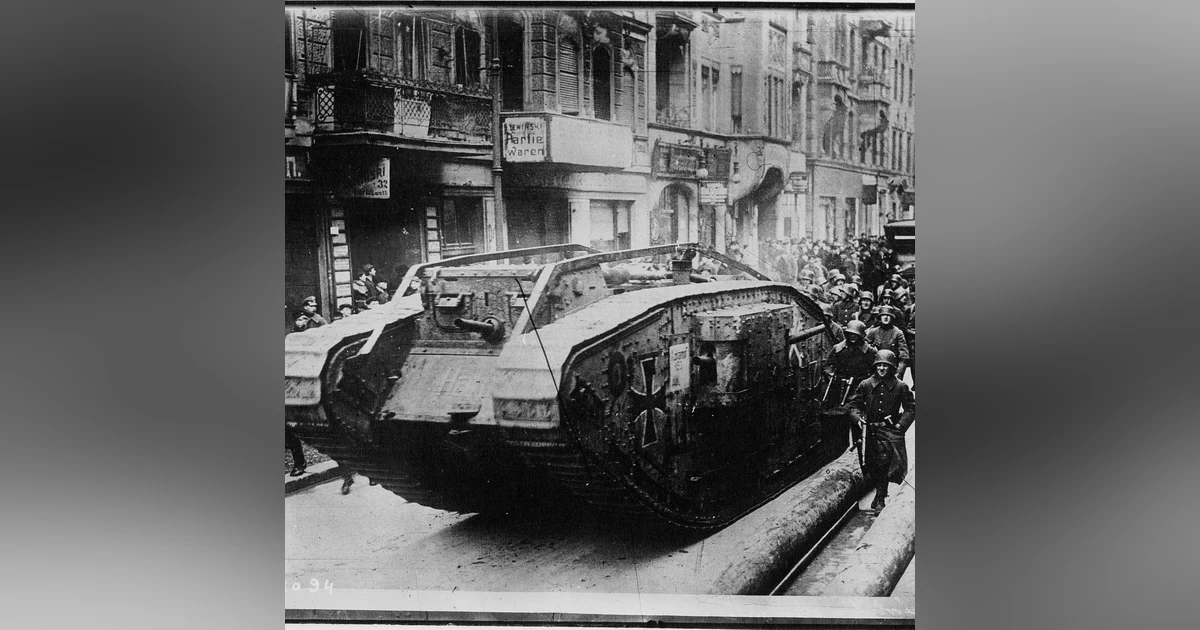


By the end of 1918, it was becoming apparent that Germany was not going to win The Great War, and that defeat would come at a price. At home, the Spartacus League looked at the apparent success of the Russian Revolution and were pressing for a similar revolution in Germany. The Kaiser departed for Holland, leaving the monarchy defunct.
Germany in 1919 is a world turned completely on its head. Even among the chaos, life goes on while people work out their future.
Image
A British Mark IV tank, captured and re-used by the German army - at the Sparticist Uprising, Berlin, 1919.
By Agence de presse Meurisse - This file comes from Gallica Digital Library and is available under the digital ID btv1b9041984h, Public Domain, https://commons.wikimedia.org/w/index.php?curid=115099225
Bibliography
DTA 3936-1 Gerhard R. "Tagesheft 1. Januar 1919 bis 10 Dezember 1919". Deutsches Tagebucharchiv, Emmendingen. DTA Reg. Nr. 3936-1
DTA 3876-3 Wilhelm von Marcard. "Briefe aus dem Revolutionsjahr 1919 in Auszügen". Deutsches Tagebucharchiv, Emmendingen. DTA Reg. Nr. 3876-3
Rabotchii Soldat, organ of the Petrograd Soviet, Vol. 1 Published October 31, 1917. Referenced in The Liberator, January 1919.
And victory shall be ours, because Spartacus, that means fire and spirit. It means soul and heart. It means the will and act of the proletarian revolution. And Spartacus, that means all the hardships and yearning for happiness, all the fighting resolve for the class conscious proletariat. Because Spartacus, that means socialism and world revolution. In our last episode, we heard from a middle to upper class woman who lived in Germany during World War I. She, along with most people in Germany, struggled to make it through the war. Among other things, she talked about the turn-up winter of 1916 and 1917, food rations, inflation, the housing crisis, and war bonds. As the war went on, the conditions worsened for everyday Germans. There began to be more social unrest, and people were looking for a new direction.
ThadRight. World War I was just hard for everybody on a lot of fronts. There was food rationing because you had to feed the soldiers at the front, fuel rationing, so coal and oil had to be sent to run the war machine. But because you're sending all that to run the war, you don't have that to keep your population warm at home. So people were starving to death, people were freezing to death, and uh in general, it just wasn't a good time. Even, you know, if you even if you weren't out in the front's line of war, things were pretty rough back home. And in fact, things had gotten so bad in Russia at you know in 1917 that the people had revolted and overthrown the government. And several episodes back we talked about the Russian Revolution. And in fact, there were two revolutions in Russia. There was the initial revolution, where they governed the Tsar and installed a progressive government that was going to basically loosen up a lot of the restrictions that the Tsar had put on them. But they were going to stay in the war and they were going to reform their society as kind of a modern republic. It was going to look a lot like what we would expect a modern-day uh government to look like. When that happened, the communists, they the Russians called them the Bolsheviks, they looked at this situation and thought, you know what? This is our time. People are tired of the way things have been, and it's time to change society in the way that we think it should go. So, really, at this point in time, you've got two schools of thought. Everyone understands, or seems to understand, that the way things have been, the monarchs, the kings of the Middle Ages and of old, are going away. And it's time to modernize everyone's government. And so the two schools of thought are this. Well, fine, we get rid of the monarch, but we keep our government looking like, I guess, similar to what you would think of as a normal government. You have people have private property, you have laws, maybe a constitution, um, you have uh democracy, people vote, you know, who's gonna be in and what they're gonna do. The communists, however, saw their goal as a utopian society where there was no government. Everyone coexisted, everyone shared property, there was no personal property, and you know, they would have have done away with the institutions of marriage, for example, everyone would be equal, and that was their end goal. We needed to just cut ties to the past and and start implementing this more radical approach to this utopia that they wanted to build right then. So you had two factions, essentially. You have the the people that are progressive, yes, we're gonna get rid of the kings of old, but we're going to have a quote normal government. And the communists who said, no, no, no, we're going to just get rid of government completely, or we're going to do something else in order to jump us to this more utopian vision. We're going to get rid of private property. And that was the division. And so up in Russia, you have the the Reds, those are the communists, fighting for taking over that, taking over the government and establishing their control. And you had the whites, which were basically everybody else. They were the people that were like, no, no, no, we don't want to do that. When Kaiser Wilhelm decides to leave, so we'll talk about here in a second, Germany finds itself in the exact same situation. Uh they or the question is, well, what comes next?
RobynRight. So the Russian Revolution took place in 1917, but by the end of um 1918 in November, it was obvious to most people in the world that Germany was going to lose the war. Um and there was increasing domestic unrest in Germany, and it was evident they weren't going to be able to turn things around. Americans had sent troops to the Western Front, and they had no way to replenish their soldiers uh like that. Um Allied blockade had wreaked havoc on their food supplies, and so they were looking to see what's gonna come next for us. So they look over and see Russia, and you have a group of people there who called themselves the Spartacus League, the Spartacists.
ThadAnd the Spartacists were like, hey, we're we're gonna do the same thing.
RobynBut what Germany had to look back on was they were only really a country for 50 years or so, and so they still had um a monarch, Kaiser Wilhelm, and um and then they'd had the parliament. But you know, it wasn't like they had 250 years of history to go back on and go back to this government that they were really entrenched in. So they knew they didn't want a monarch. The Allies had said they weren't going to um engage in peace talks with Kaiser Wilhelm. Um, and so they were looking around to see what we are gonna do.
ThadAnd Wilhelm, he didn't really have a tr a lot of choice in this matter.
RobynHe he left, but he didn't want to give up his people around him, his generals and like chancellors convinced him that Germany was gonna completely fall apart if he didn't, because like I said, the Allies weren't going to engage with him in peace talks. And if he stayed, there was going to be just an all-out civil war in Germany. Right. Excusing himself from the whole picture reduced a lot of that.
ThadRight. So he noped out and went off to Holland. He was doing okay. He he was doing a lot better than his cousin, Nicholas II, had done, where the Bolsheviks basically placed him under house arrest and then moved him off to Siberia and then eventually uh dispatched him. But yes, so Wilhelm was okay. He he he got out and lived for years on afterwards. But when he leaves, it really is a power vacuum. So you have all these pressures pushing on Germany. You have the war from the outside, which isn't settled yet. I mean, it's it is basically most people, not everyone, there's a whole there's a whole legend of like how Germany so could have won the war, and we can talk we'll talk about that later. But the allies were pressuring from the outside, um, the conditions and problems inside were were creating all kinds of social unrest on the inside. Uh the uh the king leaves, Kaiser hauls off and is out, and so the people taking over the government are are basically saying, Okay, well, we we have to come up with something new, we're gonna come up with a new government. And then on the other side, inside of Germany, you have the the communists, the Spartacus League in this situation, the communists saying, Hey, look what Russia's doing just over here. We want to do the same thing. So you basically have a an exterior war being fought and a diverge, the beginnings of a civil war being fought, almost ready to be being fought on the inside.
RobynAnd the part that we're looking at is really important because it's between the armistice, which was November of 1918, and when the Versailles Treaty was signed in 1919 in June. So we have these few months there where you have the big four of allies, France, Britain, Italy, and America, together debating things. Um, like Woodrow Wilson came up with a 14-point peace plan. Um, they're talking about what a League of Nations would look like with everyone getting along. And then even back then, the question of what to do with Russia in general. You can look back on it and be like, oh, well, you know, this was what Germany was like after the war. But at this time, there were no reparations, no war guilt clause. So the frenetic energy in Germany really was we have no idea what's going to happen.
ThadSo it's in this environment that we have that we come upon the few people that are going to tell their stories from this time period. One of them is Gard, a medical student in Berlin in 1919. Um, his account came from the Amending Archive, and he had two small journals uh where he wrote where he was studying. He was he's a medical student. Um, and so Robin, you you've studied his his stuff a lot more. Like what was your take on it?
RobynWell, he was very precise about everything he did. That um there were the two journals. One was entirely just pages and pages of his patients, the medicine, the dosage that he was giving them. So he was very precise. Yeah, it's very precise. And the other one um was a diary that was kept mainly just for the first four months of 1919. There were like a couple follow-up um, you know, a few months later, a couple pages here and there of what's going on. But it covers just this time period. He talks very, very little about himself at all. Most diaries or memoirs or people reminiscing about their lives and things. Well, I mean, we find out from him, you know, he was a medical student. He studied parasites, he talked about his surgeries, which, you know, interesting. And we we know he was um recently married, and that's all I got from him. We don't even have his last name.
ThadSo what we know is this this is a a very meticulous, precise person keeping very consistent, very uh well-ordered documents. And he's documenting the parasites and the surgeries that he's doing, and he's also documenting the social chaos that's unfolding around.
RobynRight, the fallout of the international politics. So he followed this very closely and and would even go to different debates and things. But um, he talks about the British and the Americans, French, even references Japan and uh and Turkey. Um, but because he was in Berlin, he was especially interested in what was going along on what had been the Eastern Front. So where Poland was, um, which at the time Germany had it, so it was posing and Poland was Poland was very conflicted in what it was. Um it was struggling to become independent, but was literally caught between Germany and Russia, both geographically and politically, as it had been for centuries. In one entry, he talked about a political debate that he had attended before elections in February. And it was really interesting reading that because at this time, with all the chaos, numerous political parties and organizations were formed, as well as complete fracturing of ones that had already existed. And so a lot of people were just out there expressing their opinions. And a couple that I thought were just really interesting to bring out was one of the men speaking at the event claimed that people were born and raised predisposed for which political party to support. Another one argued against annexing any territory where people spoke different languages because he believed that you could never become fully one united group of people if you couldn't even understand the person next to you, which was also an interesting way to look at things. So it's in this setting with all this going on that we're going to hear from Gerhard.
ThadJanuary 4th, 1919. The Poles are becoming ever more arrogant. They have already occupied three-quarters of Posen. The Ryan is to become international, and the independents have now left the government. Germany, pull yourself together. There's bad news in the newspaper again. Regarding the Poles, our government has reached an agreement to cede them territory. Now England will take control of Turkey from Egypt. January 7, 1919. The newspaper says the Spartacists are causing trouble. They are attacking the newspaper, Vorwartz. Endless demonstrations are happening here in Berlin, workers' strikes in Upper Silesia. The Poles are already right at the border, and because of Allied attacks, the trains are still disrupted. Als is becoming entirely French and accepting the terms of the armistice. At the same time, the Poles are still struggling for independence. There are further convulsions in Berlin, with help pouring in for both parties. In many places, the Spartacists are taking over the newspapers.
RobynSo the Spartacists were a group of well, they were radical social democrats who would rebrand themselves as communists in 1919, but they were led by Karl Liebnicht and Rosa Luxemburg. Liebknicht was the son of Wilhelm Liebnicht, and he was really good friends with Karl Marx, and he was a founding member of the Social Democrats in Germany. In fact, Karl Liebnicht was named after Karl Marx. Karl was the guy that in December 1918, so right after the end of the war and the armistice was signed, he he went and tore down Kaiser Wilhelm's flag from the Berlin City Palace and declared Germany a free socialist republic. And it was this time, um, it was December 1918 and January 1919, really, that um there was an uprising of the Social Democrats leading into the radical communists that were trying to take over Germany and uh make it more like Soviet Russia at the time. And they got pretty close. I mean, they were at the palace with a flag um saying it was a socialist republic. Um, but Karl Liebknecht and Rosa were captured by the Fry Corps, um, which were soldiers from the First World War. They were taken and executed January 15th. Um I'm gonna read a letter that he wrote just hours before he was executed, and it's called In Spite of Everything, General Assault on Spartacus, down with Spartacus. They howl through the alleys, grab them, whip them, stab them, shoot them, impale them, trample them down, tear them to shreds. Atrocities are being committed, eclipsing the Belgian atrocities of the German troops. Spartacus crushed. They celebrate from the post to the forwards. Spartacus crushed, and the sabers, the revolvers, the carbines of the re-established old Germanic police and the disarmament of the revolutionary workers will seal its defeat. Indeed, the revolutionary workers of Berlin have been defeated. A hundred of their best have been murdered. Indeed, several hundred have been thrown into prison. They were defeated because they were abandoned by the sailors, the soldiers, the security forces, the army on whose help they had relied, and their force was paralyzed by the indecisiveness and weakness of their leaders, and the monstrous counter-revolutionary mudslide of reactionaries and the property classes drowned them. Beyond all doubts and worries, indeed, Berlin's revolutionary workers were defeated and Ebert and Schneiderman have won. They've won because the generals, the bureaucracy, the robber barons, the country squires, the clerics, and the money bags, who are all narrow-minded, stunted, and reactionary, stand with them for ammunition, gas bombs, and mortars. The defeated on the bloody January week have persisted gloriously. They have fought for something great, for the noblest goal of suffering mankind, for spiritual and material salvation of the starving masses. They've spilled their holy blood for a sacred feat. Their blood was therefore sanctified. The avengers have fallen. From every tattered fiber, new soldiers shall rise from the great cause, which is eternal and unwavering like the firmament. Those who are defeated today shall be victors of tomorrow. Because defeat serves as a lesson. The German proletariat still lacks revolutionary experience. And only through tentative attempts, adolescent errors, and painful setbacks can it obtain a practical education which will ensure future victory for the living forces. Whose unstoppable growth is the national law of societal development? A defeat means stimulus. And through defeat, after defeat, their road leads to victory. The proletarian revolution, which the counter-revolutionaries hoped to drown in blood, will rise above them with great numbers. Spartacus crushed, steady. We have not fled. We are not beaten. And even if they throw us in shackles, we are there and shall remain. And victory shall be ours because Spartacus that means fire and spirit. It means soul and heart. It means the will and act of the proletarian revolution. And Spartacus, that means all the hardships and yearning for happiness, all the fighting resolve for the class conscious proletariat, because Spartacus means socialism and world revolution. And so that was the last thing that um Liebknecht left all his supporters with. He was executed just a few hours after writing that. But what he's saying is that communism wasn't just relegated to Germany. He called it a world revolution. And it was beginning to, and had by this point spread around the world. In the United States, there were deportations, imprisonments, and the first communist red scare was going on, and the government was going after anarchists like Emma Goldman and communists like John Reed. So as Gerhard continues.
ThadIn America, there are also labor demands, general strikes, etc. Fighting continues in Berlin. The Allies have ordered a 12-hour workday at 60 cents an hour. There is fighting in Munich around the main railway station. There is a general stripe in Leipzig. Incidentally, all of this news appears out today only under brief news items. The government wants a people's army for self-defense and are recruiting men who fought in the war. But what can that achieve today? Because of the inflation during the war, the English are concerned about the security of our gold reserves. There is unemployment everywhere in the Reich because under the poor working conditions, nobody wants to work. Even though the Reich government is calling for calm on election day, there continues to be as part of this Bolshevik unrest. Their revolution to make Germany more like Russia failed. Freedom of the press has turned into merely a freedom to lie. The bourgeois parties also sought some positive changes, but too slowly. If nothing came immediately of the unified school system and other aims of the communists, nothing would ever come of it. Since the public was not yet sufficiently enlightened, the elections would yield a distorted picture. The independents didn't vote, but even though they didn't vote, they refused to relinquish their power. Instead, they operated like a supervisory board alongside the government. Since the assassinations of Karl Liebnik and Rosa Luxemburg, the Spartacists have now completely allied with the Soviets in Russia. When a newly formed army was about to deploy to protect the eastern border, it came under fire from communists and Spartacists. May 10th is the day set for the peace negotiations to begin. In Romania, there are peasant uprisings. Things are beginning to fall apart. Our government will likely resort to dictatorship. Both home and factories are without coal. No one wants to work and inflation keeps rising. There are now 220,000 unemployed, and it has become clear why America is in favor of internationalization of our colonies. Mainly so that Japan doesn't get them. Schneiderman wants to become a dictator. He alone is allowed to select the cabinet ministers and leaders in government. France is afraid that Germany will pack again. President Woodrow Wilson recommends following a middle path between military and economic pressure on Germany to prevent us from building up again. We're still suffering. February 15, 1919. The Italians are requisitioning art treasures in Vienna. The Germans are being expelled from China. Belgium covets Germany's Africa, and the French socialists are recoiling. Even in the midst of all this chaos, the armistice is being renewed. Everywhere, everywhere, lies are being told.
RobynSo that was Gerhard, the medical student in Berlin. But from here we'll move on to Wilhelm Markhard. And he was a middle-aged officer who served in the First World War. Like Gerhard, he really only wrote mainly in the year 1919. But because of his background and his age, his experiences were just very different. Part of the problem with the officers coming back was that they were being told by their generals, specifically Ludendorff, this stab in the back myth, which was basically saying the military was stabbed in the back by these November criminals, they called them, people who signed the armistice in November, Jews and socialists that had turned. Against Germany, and we were actually winning the war. This government isn't legitimate. And Markard, um, who was in this upper middle class, was there the country, living in a castle near mine again, outside of a city where he was had his family in Western Germany when the war was over. So he was really concerned about his safety, which he wrote a lot about. And and one of the things that he said was to keep their daughter home from kindergarten because he was afraid that she may get shot. And he, you know, he suggested either homeschool or boarding school as alternatives if things got bad. But, you know, it's really intense when you're riding home. Hey, if you're kind of scared, don't let our kindergartner go to school because I don't want her to be shot dead in the street. I mean, that that's where he was in life. Yes, it it was pretty intense. He was also really concerned about his career, which makes sense because the military was dissolving and uh millions of soldiers had resigned from the army without finding a job first. And he didn't really know whether to stay with the military, keep earning a pretty good salary while he could, and keep that going for as long as uh he was able to. At one point, he hoped to just make it through 1919, uh, staying in that position. And he talks about use all my vacation days, which was three or four weeks for him. And then at the end of all those vacation days, just retire. And this was something he talked about several times as an option that he may do. Um, but he really was conflicted. Do I stay with the army, not the army that I've known before, or do I just leave? And part of the problem with him just leaving was, of course, finding another job. So he talks a lot about how he really, really, really wants to have a farm. And his wife's father-in-law has estates that he could go live on. And as he's talking about his job prospects, what he's going to do. At the time, the Spartacists were saying, if they took control, that they would be taking 50% of uh families' incomes for the upper middle class. And no one was allowed to own land, um, have an estate unless they could farm it themselves. And this was such an issue for him that he spent a lot of time at night reading books on how to be a farmer. He asks his wife, please send me more books on agriculture. Um, trying my hardest to learn how to do this so that we're still able to have land and still able to go somewhere. He was one of the people that was responsible for talking to the workers and soldiers councils. Uh, one of the things that they, the Spartacists said they would do was take away all the pensions of the soldiers who had served in the war. And like, what what do you plan to do? He literally was the one that went and talked to them. And then he would go back to the castle that he stayed at in Meiningen and you know, occasionally would go eat at the palace uh with the Duke and Duchess who knew Kaiser Wilhelm and would go and relay to them what the workers and soldiers' councils were saying. And so his role in this is just very interesting and very different than Gerhard's. Um, but this one gives us a glimpse into the angst and the uncertainty that the upper and middle classes were facing in Germany and the aftermath of the First World War. Because, as was the problem in Russia, when you have the proletariat, the workers that are trying to take over, they are going after the upper and middle class people. He was one of those that they were going after. And uh I just wanted to share with you part of his letters home to his wife at this time.
LeeThe palace, Meinigan, January 2nd, 1919. 1919 has begun in bloodshed. I believe that once the revolution is over, we will awake to a sober reality. Yesterday, on New Year's Day, I was invited to dine with the Duke at 1 PM. I was the only guest. We talked about a lot of local affairs and the chaotic situation in Brunswick. The Duke and Duchess have received good news from Kaiser Wilhelm in Holland. The food was wonderful, and the palace magnificent. It was comforting to be surrounded by such princely splendor. Both the Duke and Duchess are astute and understand the gravity of our situation. We shared many memories from our time in Berlin. I was graciously dismissed with the invitation to come back more often, without needing a formal announcement. Tomorrow I must speak with the Workers and Soldiers Council. They have taken control of the Duchy of Saxe-Meiningen. I asked for the meeting and hope to talk to them calmly and peacefully. It helps significantly that the local authorities side with the Social Democrats, who are far more moderate than the radical leftist and Spartacists. The German army is now nearly entirely demobilized. They have been transformed into a people's militia. Soldiers, veterans of Vervor Von, are no longer receiving government benefits. Today the soldiers council met for two hours. The Social Democratic Trade Union leaders speak well, use propaganda, and are able to rally a crowd. I was able to gain a lot of insight into their organization. I spoke for over an hour. There were no incidents, and we came to a peaceful agreement. This cannot continue for long. I will not be here much longer. However, I think that I should hold on as long as possible for now. Things will get more difficult soon. There will not be any coal delivered for several months. Our garrison supply only lasts until the end of this month. Looting will begin once things start to freeze. Everything is wretched. Our troops are completely demoralized and are defecting en masse. I feel like my military career will soon be over. Conditions are becoming increasingly bleak and hopeless. Everyone feels powerless to do anything to change the circumstances. With the chaos surrounding us, there is no motivation to work. The National Assembly elections are 14 days away. We will have to become accustomed to being part of the lower middle class. A general wealth tax is coming. The government is taking 50% of anything over 30,000 marks. Vor taxes and inheritance tax are also being considered. This will hit the middle class the hardest. If this happens, we cannot buy our own farm as we have vaunted. We would barely be able to buy a house with a large garden in the countryside. Billions of dollars are being wasted on propaganda for socialism. There is no better platform than unemployment benefits, and to pay for soldiers to receive three to five more marks per day, January 7th. The situation here is verse, but still bearable. Zerar street battles in Berlin. If they come to power, then everything will instantly be over. The Second Reich will be over. Some believe it has already come to that. Ebert's government is disbanding the standing army and establishing a Freikorps. I can already picture myself living day to day. If the Spartacists win these street battles around Germany, they will do away with pensions, and the National Assembly will not meet. There is heavy fighting, and the Spartacists control major cities throughout the Reich. In Brunswick, there is pure chaos. I hope to stay here, collect a salary as long as possible, and try to forget the hardships that will come. Secretly, I hope that Ebert's government will hold and suppress the rabble. Communication is nearly impossible. If you fear for your safety, Anne Marie should not go to school. The railroads are still only partially open, and we must fate to see what happens with the street fighting in Berlin. I knew this was going to happen, but I never imagined it would be this bad. January 10th. I must consider whether to take extended leave or try to remain at my post. Our military will not last much longer, so we must take control of our future and find an estate with a farm. We can get a kindergarten teacher for the kids. Please send me some books on farming. I need to learn more. I plan to spend my afternoon in the quiet of the old castle, reading, writing, and taking an afternoon nap. Do not worry about me, this is a small town. Even if the Spartacist were to attempt a coup, it would only affect me secondarily. The main concern is the Workers and Soldiers Council. It would be difficult to find a better place to stay. After the signing of the Treaty of Versailles, people have completely lost their sense of leadership and stability. Currently, train connections are still terrible. I often think of the families in Alsace and Lorraine now destituted and defenseless against the French. Many of them still have husbands out there, and have heard no news of them. They are going through a truly hard time. At least we can discuss and prepare for our future in peace. And for now we still have an income and food. Berlin seems to be calming down. Ebert and Schneidermann, the Social Democrats, have won a victory for now. Today, january sixteenth, there was a large conference with the Workers and Social Council. The main thing is to get through the political climate right now. By autumn, conditions in Germany should have stabilized again. Please consider whether you think I should resign or continue in the service. I will go along with whatever you decide. If kings become dangerous, you should leave. By next year, hopefully the verst is over. January 18th. Tomorrow's election will decide Germany's future, assuming that the election is able to take place at all. New coup attempts are expected throughout Germany, particularly since the deaths of Rosa Luxemburg and Karl Liebnik, communist murdered on January 15th, have provided them a reason. Ebert's government remains weak, even though the troops are being successful. The Entente is becoming increasingly demanding and continues to strangle Germany. We are all but ripe for suffocation, but people still don't realize it. The German National Party is unable to control the agitation by the Reds and the Radicals. We are poor, defeated, godforsaken people. I feel like I am walking on a tightrope with the abyss formed by the Workers and Soldiers Council, which is moving increasingly towards the Spartacist. I hope to take leave for 14 days and come see you all. Spartacists have occupied Eisenach and is blocking passenger traffic at the train station. It is quite simply a return to the highway banditry of old. January 19th. Yesterday the workers and soldiers' councils deposed the Lord Mayor. I try to only intervene when they are making decisions and try to stay out of personal issues. The men treat me well, even so everything around us is descending into chaos. I now have to raise a rifle regiment, even though I am not commanding it, and am getting no volunteers. The Imperial government is authorizing house house searching and collecting hoarded things. But do not be afraid. January twentieth. The Socialist had a strong showing in the election here. Other parts of Germany should get the same results. Only in later elections, after a disaster happens, think about whether it would be better to leave the city now. It would be terrible if our children were endangered by a stray bullet. School is not that important. Safety should be our primary concern. It would be best if you could stay at your father's estate in the country. But I would take you in here in Meinigan as well. Now that the National Assembly has been elected, it is calmer for now. The bourgeois hold a slim majority against the socialists. I am anxious and worry about you. Always remember that I love you. Keep your chin up, and we will get through this. You can see things are not simple. Because I foresaw the collapse and the chaos, I am no longer surprised by anything. In the evening before bed, I study how to do farm work. Monday, January 27th. The decree about command authority has upset the Workers and Soldiers Council, and I expect there will soon be protests. January twenty eighth. I ate with the Duke, and I still can't decide whether to resign from my post or reapply. I decided that we must wait until after the National Assembly to make a decision. I still don't know enough to farm. And if the owner of land doesn't farm it himself, the land will be taken away. We must come up with something to do about our estate so that it is not taken away. February first. The Communists have declared war on Ebert's Reich government. When it gets warmer outside, I think there will be another revolution. My friend escaped from the rebels under cover of darkness, and officers are being hunted. The revolution is only beginning. I think my time in the army can be measured in weeks, not months. I think I am too old to learn to farm, so I am using the time for rest. This is a terrible time to live, but my thoughts wander to past war years. At least the Great War is over, but I am sure that spring will bring famine and anarchy. Supplies will be exhausted and industry paralyzed. No one vaunts to work. A strong nationalist leader would be the right man to put us back on track. I think that a second revolution is likely and the government is powerless to stop it. There are struggles over command. I plan to take a leave of absence and then resign. This purge achieves little because I know that Spartacists and the Communists will rise again february sixth. People are trying to help us get out, and I am certain that everything will be okay. The only question is whether I will be granted entry to Bronswig without a problem. If it is difficult, then maybe we can meet in Hanover, and the children go to Grossman's boarding house. I will return home or to Hanover by March first. And we can figure out what to do. I want to at least wait through the summer at my post to ride out nineteen nineteen still earning a high income. A lot of people are sitting on the street because they have nowhere to go and resigned too fast from the military. Only if the government remains strong can we control the spread of Bolshevism. They would love to scatter the National Assembly. Workers and soldiers councils are fighting for their existence. Industrial population ready to march on Weimar, trying to strike, but I think they will leave at the first shot. I am sorry that you suffer so much from our separation. It is hard for me too, but at least we know that we will be reunited soon, and that we can call and talk to each other on the phone. In Ukraine and the Far East, people are still separated, and officers' families in captivity, dealing with abuse in enemy occupied territories. We never know what the next day will bring. Dictatorship of the proletariat is horrible and surrounded by spies. Coal shortages will cause public buildings to close. You should stock up on fuels, peat and wood for the coming weeks. Cost doesn't matter. If we get peace, right now there is just the armistice, our income will rise because our state income is important to our finances. February eighth. The Spartacist threat is back and there are fierce battles and open rebellion throughout the country. Gotha is occupied and Weimar paralyzed. Can the assembly wipe them out? Thuringia workers are all armed and ready to fight, although in the majority the bourgeois party is irrelevant. February seventeenth. I submitted my request for leave. It was going to happen eventually. I know that this is terrible news, but I can't stay here in Meiningen. Even if we could find the tiniest place, with only four rooms, that would be okay. All apartments are taken. Thousands of people are waiting for a home. As it is, we may have to bid on one. The Entente will put Germany into servitude. The hard times are not over yet. Munich and the Rhineland are in chaos. Unemployment continues to rise everywhere. I am still studying agriculture, but remain under constant surveillance and suspicion. Trains still having issues, so I cannot travel long distances. Got to be with you, your Ollie.
RobynSo that was Wilhelm Markhard's account of the first few months of 1919 in the German countryside. And Markhard took that guessing game out for me because he actually included some news clippings from himself from when he was advertising rebuilding the army that you talked about in early 1919. And he was looking for upstanding men to be officers. In addition, some family members or people that have known the person with documents in the archives, um, add to them. And um Marquard's daughter left a note in his file. And her addendum said that he was eventually able to learn how to farm and that that he and the family were able to keep one of the father-in-law's estates.
ThadSo so he did learn to farm.
RobynYeah, he learned to farm.
ThadSo when he when he made this transition from what he was doing before to becoming a farmer, do we know do we know how old he was? He was middle-aged. So he wasn't a young guy. This wasn't like right out of school.
RobynHe was like No, no, because he was up in the officer ranks, um, overseeing people, talking to the soldiers' councils. He was not like a really young guy. He already had a strong, established life in the city where he'd been his entire life um and only knew that life and um and worked hard to learn how to do something new.
ThadOh yep, I'm I'm not here far I'm a farmer.
RobynYes, and his daughter said um that he never regretted it, the change that he actually you know loved being in the country. And so sometimes you just you just have to take a leap of faith and and hope that it works out. In Mark Hard's case, it did. His kids grew up in the countryside, and um and so that was his story.
ThadRight. So what we're seeing here through Markard's story and his description of the things that are happening around him is uh Germany, the German people struggling with their identity. They're they're having an identity crisis. And uh part of the reason for that is that everything is changing. The old order, the way of things, the kings of old, the Kaiser has left. And now the question is well, what do we do next? This is even more difficult than it had been in the past because uh on the table now is this idea of of communism. And communism looks at itself not as a regional identity, right? It's looking at itself as a class-based identity, a group of people that are bound together not by how close they are to their neighbors, but by their ideas, right? So, you know, back if you look if you look at this area and this time in history, or even many times in history, people oftentimes identify themselves by who their neighbors are, or people that speak the same language, or people that have the same customs, or you know, people that are are similar to them.
RobynWhich is why it was very interesting when Thad and I did some research in Austria, and I was talking to the man at the archives there, his name was Paul, and he said, Do you have any relatives from here? And I said, Oh, well, yeah, in Bavaria, you know, the boundless burgers and my family traces back that far. He looked at me and he said, Well, that's another country.
ThadRight. He was just like, What are you talking about? This that's a long ways away.
RobynAnd I said, Well, listen, in Texas, it's like it's three hours to the closest city. So it's a very different perspective. But when you're driving even now, uh, like we were driving, and you reach the border of Austria and Germany, and there is just a totally different vibe. Right. So it is, you know, they there still is the identity of you, um, in this specific case, Austria and uh and Germany, um, that both see themselves as the same, but they're next door neighbors, um, yet they still feel that they're very different from each other.
ThadThey have their own individual, they have their own unique style.
RobynYes.
ThadRight? So so at this point in time, everyone not only is dealing with, yes, they have similar languages, yes, they have similar uh history and past, but now there's this idea that your neighbors, your brothers and sisters might not be your next door neighbors, but they might be the revolutionaries over in Russia, or the people that share the same ideas in France or in Britain or in the United States. And so this ideology, the communist ideology, held that the revolution that was coming wasn't just a Russian revolution, it was gonna be a worldwide revolution. All the people that were revolen, workers of the world unite.
RobynThat was their slogan.
ThadRight. Absolutely. They all believed that yes, Russia was the first step, but really Germany was gonna follow, and France would follow, and Great Britain would follow, and even at some point the United States, it might take a little while, but they would get there too.
RobynWell, I think also we need to talk about um Marx, and he really didn't see this starting in Russia, right?
ThadNo, in fact, Russia was seen as too immature for the revolution to come to. So, really, Marx believed that for sure Germany would lead the way in the communist revolution, or maybe France, or possibly Great Britain, but Russia was was pretty far down on everybody's list of the places where the communist revolution is first going to happen. And so when that when the opportunity presented itself and Lenin got on the train and you know went across Germany and and had you know led the revolution there, it really was kind of kind of out of the blue. Like nobody really expected that.
RobynNo one expects the communist revolution.
ThadNo one expects the communist revolution, right? So it's happening in Russia, and there people and uh many of the people in Germany were looking across and saying, well, maybe maybe this is something we should do as well. So uh let me read you something. Uh an article published by the Russian Soviet uh shortly before the Bolshevik Revolution in 1917, and they had has this excerpt. Quote The German Kaiser, covered with the blood of millions of innocent dead, wants to hurl his army against Petrograd. Let us call to the German workmen, soldiers and peasants, who want peace, not less than we do, to stand up against the stand war. This can be done only by a revolutionary government, which would speak readily for the workmen, soldiers, and peasants of Russia, and would appeal over the heads of the diplomats directly to the German troops, fill the German trenches with proclamations in the German language. Our airmen would spread these proclamations all over Germany. So the Russians really saw a way to end the war as basically to say, look, we've thrown over our we've thrown off our government. Um our czar is gone. How about if you get rid of your czar and then we can just we can just call an end to these hostiles?
RobynWell, we real we also have to look at the date that it was published. Um this was October 1917, so time of the Russian Revolution. And Lenin, Trotsky, and the Bolsheviks had come to power promising an end to the war. Right. And one of the uh ways that the communists worked was to give a lot of propaganda to the troops. Um, and so that was one of the methods that they used. But we just have to remember that this was still, you know, a year out from when the actual war ended, and Russia was just like, come on, guys, we can end it now, we can join together.
ThadRight. Right. But the this propaganda and this idea that the the workers, the soldiers, the basically the the people doing all the work, not the you know, not the elites, right? The the people on the ground, those are the people that are going to be in charge of the new world. So the unrest that we see, the reason that you know we have to have a FRICOR, the reason that we have to have all the people brought up in order to put down the revolution happening inside Germany, is because the revolution is there. There are a lot of people that are looking to make changes in Germany and possibly take it in the same direction that the Bolsheviks took Russia.
RobynAnother example of this identity crisis that Thad was talking about earlier is that there were two cities in Germany, Munich and Berlin, um, that were in fact very different. Um, but it's looking at Germany as a, you know, who are we? You had the Spartacists and the Spartacus League in Berlin creating unrest. And then you had Munich, which was much more laid back and had a very Bohemian type spirit. So we heard from Gerhard, who was in Berlin, and Wilhelm Markard was in the countryside, and and then there were several other accounts that I've read that are all calling out the chaos in Munich, um, specifically in the late spring of 1919. So this was after the first uh elections had been held in February, and you know, it was after like the first um spat of chaos. And um and I want to um just Max Weber was a famous sociologist, and he called the politics that were going on in Munich 1919 a bloody carnival, which it really was. It Munich was a fundamentally different place and had a very different culture um than Berlin. And it's it's in South Germany, next to Prussia, it's really the only region you hear about prior to 1871. Um for the Disney fans out there, it's where the Castle Neuschwanstein is located that you know is Cinderella's castle when you come into Disney World. Um, and it's located not far from Austria, and it's just much more laid back. Um and it had its own personality. When I think of Bavaria, I think kind of like Texas. You know, it's part of the US, but they have their own thing going on, and they're very proud of it. Oh, did you mean the Republic of Texas? Oh, yes, the Republic of Texas. Yes. Yeah, we were we were our own nation there for a little while. 1836 to 1845, man.
ThadThere we go.
RobynOh but yes, the um the Republic of Texas, very much um individually minded. And in fact, after the war, a journalist, uh, his name was Kurt Eisner, um, he was able to organize and he succeeded with a socialist revolution in Bavaria. And he renamed the whole region the People's State of Bavaria and hoped that it would have its own independent government, become its own country. Um, kind of like in the Civil War when Tennessee tried to break up into the state of Franklin and the state of Tennessee, with East Tennessee becoming the state of Franklin. Um so he argued that going to war was Berlin's thing. It was, you know, all Berlin, not the fault of the Bavarians. It didn't work out. But he used um some documents that were from the Imperial Chancellor of Germany to Austria in early summer of um 1914, um before World War I broke out, promising them that if they went to war with Russia, that they would support Austria and go to war with them. And he's basically saying, look, guys, that's Berlin, not us. Treat us differently. Um but by the end of 1919, the people statehood of Bavaria had fallen apart. Um, leftists who were funded by Lenin of the Russian Revolution and used the motto workers of the world unite, um, established um a republic in Bavaria. And in German, it's the Reita Republic, and Reita means council.
ThadWhich means which is the same, which is the same word as Soviet in Russia. So so they were trying to create a another Soviet state.
RobynAnd even if you look it up online, uh I think it pops up as like the Bavarian Soviet Republic. But yes, the leaders of the radical movement in April were executed um in May. And shortly thereafter, at the end of June, it was five years to the day of the assassination of the Archduke um Ferdinand of Austria, which is what triggered, well, the shot heard around the world. That's where some people pinned the start of World War I. That's a debate for another day. But it was June 28th that the Treaty of Versailles was signed, which in every possible way included Bavaria as part of Germany. Uh, so they didn't get out of the war guilt clause. They still had to pay reparations. Uh it was it was still, you know, they were included in it.
ThadUm they were Germany. Yeah, they were Germany. Everyone knows like, look, you may call yourselves Bavarian, but really we we know you're Germany.
RobynWe we know it. You you decided when Bismarck tried to unify all of y'all back in the late 1860s and then in 1771 when you finished it, y'all decided to go with Prussia. So that's on you now.
ThadThe so you're saying the French did not had not forgiven them for the Franco-Prussian War?
RobynNo, because they were, like I said, like the second most important and biggest province in that area at the time.
ThadWelcome back to Versailles, Germans.
RobynRight. At any rate, the uh Bavarian Soviet Republic um only lasted about three weeks, and uh but Munich was just one example of a sad places all over the world who were going through a who am I crisis um after World War I. You had the British Empire was breaking apart, uh, the colonies were becoming independent, the Ottoman Empire was no more, and Germany had been pushed back. Russia was in the midst of famine and a brutal crackdown at this point by the Bolsheviks. By 1922, they would become the USSR. Even in China, the Qing dynasty, which would be the last um Chinese dynasty, was in its final throes. Um, and the US at this point was emerging as a global superpower, partially because everyone else had been beaten down by war. Um, but it was out of this chaos that this new, often more nationalistic uh ideologies would take root and spread.


